Most corporate training in critical thinking follows a predictable formula. A consultant arrives, delivers a framework, hands out a workbook, and leaves. Participants feel briefly energised, then return to exactly the same habits of thought they had before.
We offer something different, centred around a principle that we’ve spent more than two decades developing.
What is ‘authentic critical thinking’, and why does it matter in the workplace?
The most costly mistakes in professional life are rarely technical. They are epistemic. They happen when talented, experienced people mistake confidence for accuracy, confuse consensus for truth, or fail to notice that their assumptions about a market, a client, or a strategy have quietly stopped matching reality.
The ability to identify and challenge your own biases is not a soft skill. It is the most important professional skill there is, and it is almost never taught.
Authentic critical thinking (ACT) is built around a single, deceptively demanding principle: that the most important intellectual task is not to find evidence for what you already believe, but to actively seek out what challenges it.

Who are our epistemic heroes?
Our workshops draw on thinkers whose ideas are genuinely transformative, and who have changed the way professionals, leaders, and organisations understand themselves and the world around them.
Here is a selection of the key figures who feature in our sessions, each with a video that gives you a flavour of the ideas and approaches we bring into every room we work in.
John Stuart Mill
He who knows only his own side of the case, knows little of that.
Alex Edmans
We often have the discerning skills already within ourselves. We just need to overcome our biases and deploy them.
Julia Galef
Scouts are grounded. Which means that their self-worth as a person isn’t tied to how right or wrong they are about any particular topic.
Hannah Critchlow
Once you have built up a perception of the world, you will ignore any information to the contrary… changing the way that you think is going to be quite cognitively costly.
Donald Hoffman
Letting go of dogmatism… Being clear about our current ideas… Avoiding false arguments over nonsense… Finding out precisely why we’re wrong, where we’re wrong… Learning the most quickly.
Sasha Sagan
Tolerating ambiguity, waiting until you have evidence, knowing that sometimes the evidence will change, is central to any scientific advancement.
Why outsiders make the best problem-solvers
The most productive breakthroughs in problem-solving so often come from outside a field, and for good reason. Insiders share the same assumptions, the same frameworks, and the same blind spots, and have invested too much in existing ways of thinking to question them freely. An outsider, precisely because they do not share those investments, can see what insiders cannot.
Julia Galef calls this the difference between the soldier and the scout: soldiers fight to defend existing positions, while scouts go out to discover what is actually true. Most professional cultures, whatever they claim, produce soldiers. We help you train scouts.
We come from outside the corporate world, and we make no apology for that. Twenty-five years of helping people of all ages challenge their deepest assumptions has given us a clear-eyed, unsentimental view of how human beings actually think, and how stubbornly they resist thinking differently.
We bring that perspective into every session we deliver, along with the tools, the thinkers, and the approaches that have changed the way thousands of people see the world. The same principles that make a great critical thinker in any context apply equally powerfully in a professional one.
Who are our sessions for?
Our sessions are for anyone who makes decisions, communicates ideas, or works with other human beings. They are particularly valuable for leadership teams navigating complex environments, organisations where groupthink has quietly become a structural problem, and professionals in fields where ethical reasoning is central to good practice.
They are also for anyone who suspects that the quality of their thinking matters as much as their technical expertise. The most effective professionals are not always the most knowledgeable. They are the ones who know how to evaluate what they know, recognise what they do not, and remain genuinely open to being wrong.
What do people say about our workshops?

“Having a TOK integration workshop with Michael Dunn was the best thing I’ve done as the TOK Coordinator!”
As well as the hugely positive (unsolicited) reviews of our workshops below, you can also see what people have been saying about our teaching and learning resources, and the support we provide our customers, on this page.
Very pleased with how things went. And again, wonderful to see how we seem to be in sync with our approach to TOK… Great feedback from students and teachers as they left just now.
Paulo Arruda, Head of Social Studies, Hiba Academy, Shanghai
Have completed my first week as a TOK teacher. I’ve overheard the students saying ‘So, this is how TOK lessons were supposed to be’, ‘Time passed so quickly!!’ You can imagine how that made me feel. Thanks to your wonderful resources, I am making headway, and enjoying it tremendously. Thank you for being an inspiration.
Jenny Chavush, Işık High School IB Diploma Coordinator
Thank again for your session last week it was exactly what the students needed.
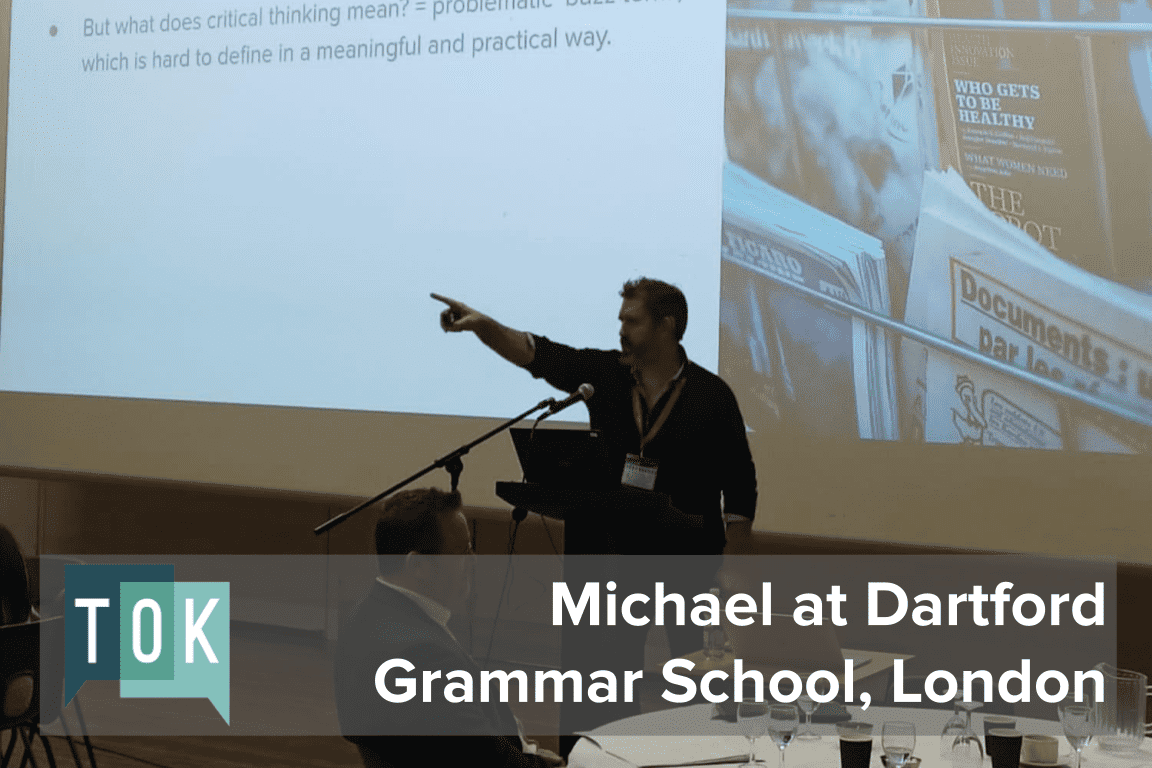
Dan English, Head of TOK, Dartford Grammar School
We really enjoyed Michael’s workshop, it was great to see the staff so enthused and inspired!
Susannah Porsz, DP Coordinator, Anglo-European School
We were delighted to have Michael present over two full days in January. Michael delivered a workshop to a variety of teachers repressing 11 local schools. The workshop allowed fantastic opportunities for teachers to gain insight into the new TOK course. In addition, the student workshop provided fantastic high quality student engagement through a range of activities. Thank you for delivering two very successful workshops.
Hannah Cashell, TOK Coordinator, Gulf English School, Doha
Thank you again for spending the days with us; students were buzzing for a while after, and the ToK team appreciated the opportunity to connect, think, and talk ToK. Hope we have a chance to work again in the future.
Dasha Lis, Head of TOK, UWC Maastricht
The feedback I have had from the teacher workshops has been really positive. My colleagues really approached your personable style and found the content engaging. Everyone felt they had an immediate takeaway and a better understanding of TOK generally. We’d love you to come back and do more.
Joanne Perkins, Head of TOK, International School of Paris
I can’t say how thankful we are for your visit. Chatting to the students yesterday showed that they really felt the day helped them to grasp the essential concepts of TOK in a way that had thus far evaded them. Feedback was all positive and many have gone on to plan their final presentations on the back of ideas that came to them during the day.
Kieran Hennigan, Head of TOK at St Julian’s School, Lisbon
Thank you very much for the ToK workshop… as a ToK novice, I found it incredibly interesting and reassuring.
Alex Waring, CAS Coordinator, St Edward’s School, Oxford
It was a real pleasure to have you with us, and the sessions were extremely well received by both our primary and secondary colleagues.
Matthew Wemyss, Assistant School Director, Cambridge School of Bucharest
Thank you so much for your amazing workshop. To be honest, no-one was looking forward to it after another dispiriting day of online teaching in lock-down… This made it all the more surprising to find it so lively, entertaining and immediately relevant and useful to our teaching. Everyone I’ve spoken to agreed that it is the best PD workshop they remember at our school.
Simon Jackson, DP film teacher, Shanghai Singapore International School
Having a TOK integration workshop with Michael Dunn was the best thing I’ve done as the TOK Coordinator. Michael’s knowledge, enthusiasm and practical tips for the subject were a great inspiration for the whole faculty.
Jana Jackson, TOK Coordinator, Shanghai Singapore International School
Thank you so much for the sessions you led with us, the TOK team is certainly feeling more confident in their teaching of the two assessments of the course and you have given me lots to think about in terms of the way we currently approach TOK.
Charlotte Nicholas, TOK Coordinator, Westminster Academy
Yesterday we had a TOK collaboration meeting, and the feedback from the workshop was fantastic! Everybody was happy… we need people like you!
Dorothee Prendergast, Head of Languages, and TOK, International School of Luxembourg
[The workshop has given] a broader, more complete/intuitive understanding of the course, will certainly improve critical thinking and subject connections. Great ideas for new and innovative practices and approaches to teaching the course. Good preparation with tools, tactics and new ideas. Very helpful. Very practical, and offered concrete ideas on how to approach the course. Terrific opportunity to collaborate and share ideas with the speaker and my colleagues. [This will] Help students how to understand ToK better by improved teaching schedule and lesson structure. The structure of the 8 questions programme makes so much more sense.
Feedback from the ISL teachers, following Michael’s visit to Luxembourg in January 2017
As an IBDP coordinator who has attended your workshop at Nesibe Aydin Schools in Ankara, I would like to thank you for the great ideas you have shared with us.
Müge Özgönül, IBDP & CAS Coordinator, Eyüboglu High School
Thank you so much for delivering your ToK session. Staff were really energised by it!
Tricia Kelleher, Head of School, Stephen Perse Foundation
Organize a training session
We’ll be happy to answer any question you might have about our workshops, and set up a session for your organization.
These might include locations we’re able to travel to, how to decide on a topic for training, details of workshop fees, which members of your learning community we can help, and the pros and cons of in-person vs. online workshops.