At the heart of everything we do is the development of authentic critical thinking (ACT). This means giving students the tools to identify and challenge – rather than confirm – their biases and assumptions about the world.
ACT is most effectively deployed as a continuum of learning, rather than in the last two years of school. Below we outline how this works both in principle and practice.
The ACT & TOK teaching and learning pathway
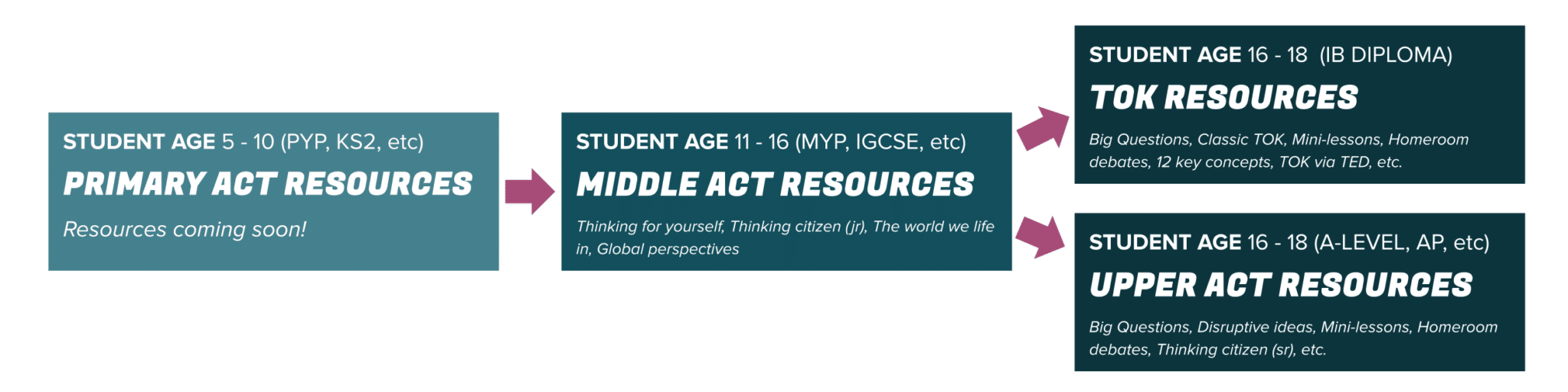
Placing ACT at the heart of what we do creates a learning pathway moving from our middle years resources through to either the TOK course, our senior ACT resources, or our dedicated materials for students following A-Levels, the AP, or other non-IB programmes.
Our resources can be plugged into any timetable – as full-length courses, (including our new dedicated course for American Diploma students), short mini-lessons in PSE classes, kickstarters for EPQ or HPQ slots, or critical media studies in optional enrichment sessions.
Cognitive aims of the ACT continuum
The infographic below shows our cognitive aims for learners, and the outcomes to aspire to by the end of each stage of their journey. We use the key concepts as a scaffold to develop ACT skills.

Key thinkers who have inspired ACT
Our approach to critical thinking has been informed by many key thinkers, among them John Stuart Mill, Julia Galef, Alex Edmans, and Sir Ken Robinson. Each has shaped the way we think about what authentic critical thinking means, and what it looks like in practice.
John Stuart Mill’s observation that “he who knows only his own side of the case, knows little of that” is the founding principle of ACT. Julia Galef’s distinction between scout and soldier mentalities develops this further, and her insight that scouts are people whose self-worth is not tied to being right is, for us, one of the most important ideas in education.
Alex Edmans (see video) reminds us that critical thinking is not an elite skill reserved for specialists. “We often have the discerning skills already within ourselves,” he argues. “We just need to overcome our biases and deploy them.” Sir Ken Robinson’s insistence that education must be personalised rather than standardised underpins our entire approach to ACT as a framework for developing genuinely independent minds.
All of these thinkers feature directly in our full-length courses and mini-lessons. We believe that if an idea is not engaging enough to share with students, it should not be driving our pedagogy.

Help yourself to these samples – then join us!
Download an huge range of free sample materials, showing our innovative, compelling, and provocative approach to teaching and learning. If you like what we do, join us here. In the meantime, subscribe to our free monthly newsletter, The Examined Life, which will help you to make sense of a challenging world.